
Intro
foldable phones
were the first to grace the market, there has been plenty of time for the competition to catch up. Last year, Motorola did just that with the Razr Plus (2023), and we would even say that it was superior to the Galaxy
Z Flip
in some ways.
Razr Plus
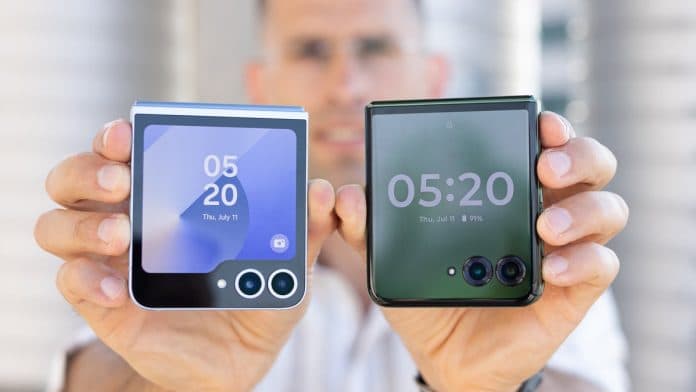
(2024) might be superior in even more ways than last year’s generation. Thanks to its larger cover display and mostly invisible crease, the Motorola stands out a lot more in 2024 than Samsung’s new Z Flip 6.
What’s more, the Z Flip 6 costs $100 more for its base variant with a price tag of $1099. That makes the new
Razr Plus
even more appealing at its $999. But, of course, the devil is in the details. Some buyers might prefer the benefits of the
Galaxy Z Flip 6
, while others those of the
Razr Plus
, so let’s see how the two compare.
Galaxy Z Flip 6
vs
Razr Plus
(2024) differences:
| Galaxy Z Flip 6 | Razr Plus (2024) |
|---|---|
| Somewhat smaller size at 2.83 x 3.35 x 0.59 inches (folded) | Larger, coming in at 2.91 x 3.47 x 0.60 inches, but also with slightly bigger displays |
| More capable flagship chipset | Chipset is still capable, but not on par with other flagship processors |
| 12MP ultra-wide as secondary camera | 50MP 2X telephoto instead of an ultra-wide |
| 10MP selfie camera | Higher-resolution 32MP selfie camera |
|
25W wired charging |
Faster 45W wired charging |
| Main display has a 120Hz refresh rate and cover screen maxes out at 60Hz | Main display has higher 165Hz refresh and cover screen is noticeably smoother with 165Hz |
| Main display has a more noticeably crease | The crease is barely an inconvenience |
| 7 years of software support | 4 years of software support with 3 major OS updates |
| Supports Galaxy AI | No on-device AI features you can actively use besides generating wallpapers |
| Starts at $1,099.99 for 12/256GB memory and storage variant | Starts at $1,000 for 12/256GB variant |
Table of Contents:
Design and Display Quality
Motorola holds the lead
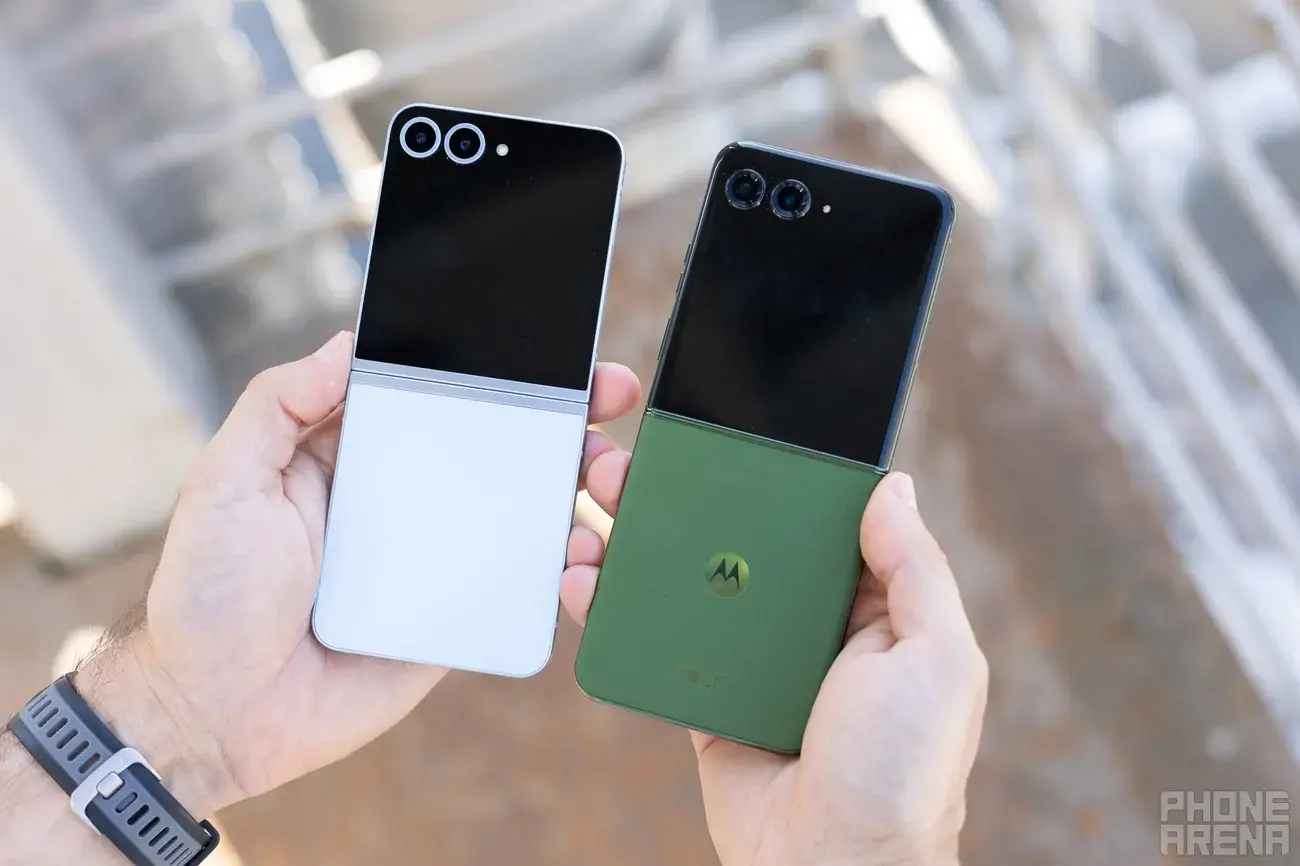
The Galaxy Z Flip 6 and Razr Plus (2024) shown from the back (Image by PhoneArena)
If you are looking for the most compact flip
phone
between these two, then the Z Flip 6 is the one you should check out, as it is considerably smaller than the 2024
Razr Plus
.
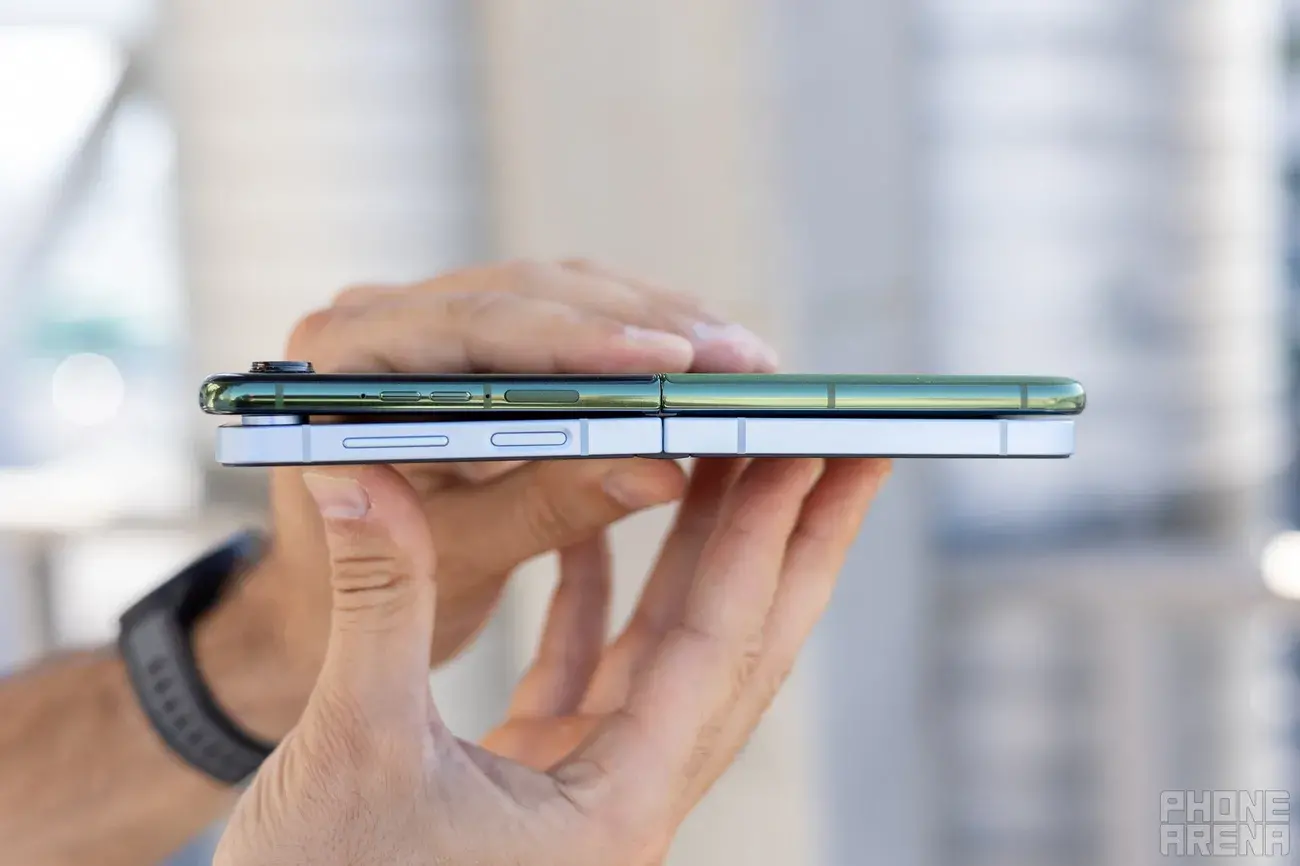
The new Razr Plus is thinner but the Z Flip 6 is shorter and more narrow (Image by PhoneArena).
Durability is also a factor here, with the
Galaxy Z Flip 6 coming with a higher
IP48
dust
and water resistance rating vs. the Razr’s IPX8. That said, the “4” in “IP48” references large particles of 1mm and larger than the dust we are used to seeing at home. Still, the Razr does not have that type of guaranteed protection.
The Z Flip also has Gorilla Glass Victus 2 protecting the cover display, whereas the
Razr Plus
has Gorilla Glass Victus (1st-gen), making the cover display on the Galaxy more durable.
As for their looks, surprisingly, Samsung did not include a larger cover display with the Z Flip 6, which makes the
Razr Plus
(2024) stand out with its cover screen that spreads throughout the whole upper part of the back panel. The Z Flip, on the other hand, looks a bit outdated in comparison.
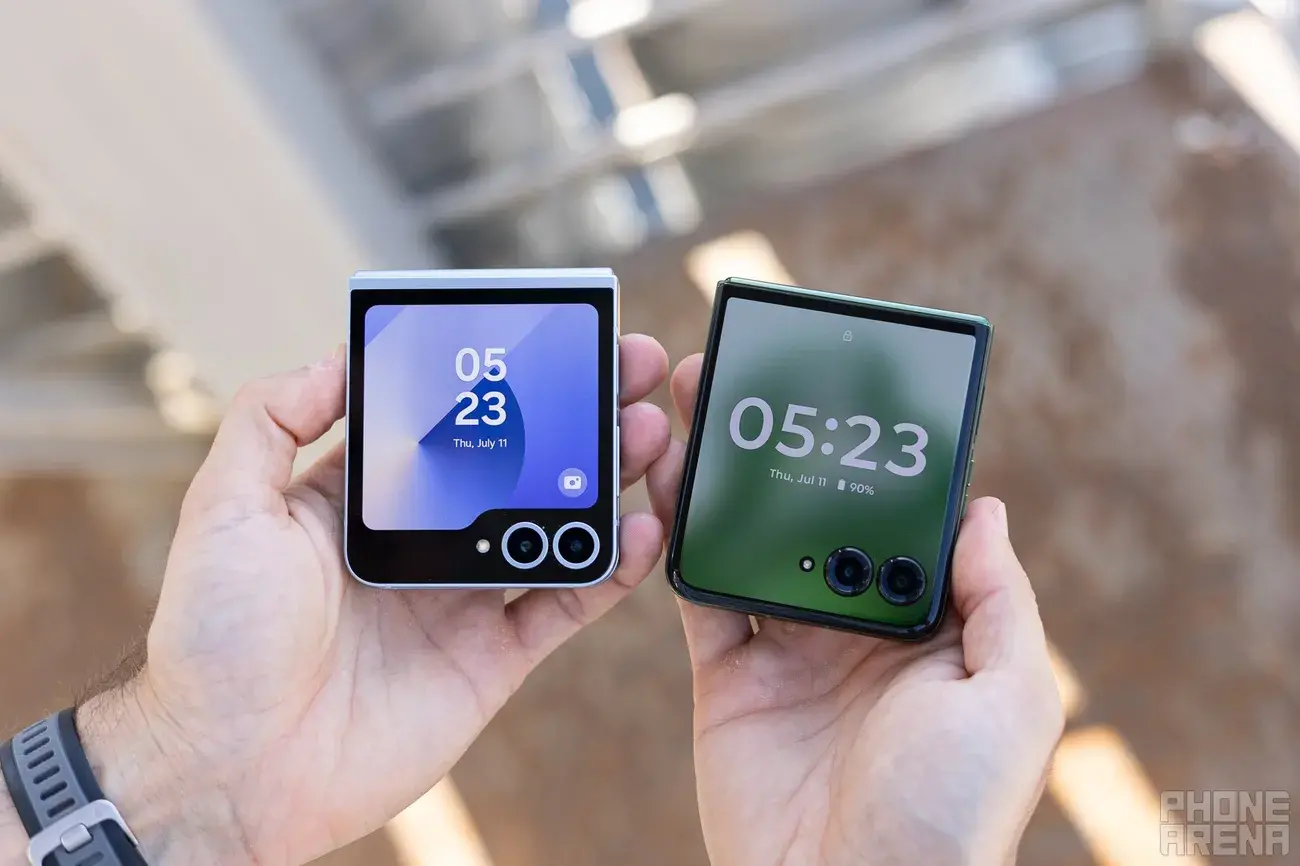
The Razr Plus (2024) looks so much better than the Z Flip 6 when closed thanks to that massive cover display (Image by PhoneArena).
Adding even more brownie points to the
Razr Plus
(2024) is the fact that its inner (foldable) display barely has a crease. Initially, we thought that Samsung has also achieved a similar feat with the Z Flip 6, as at first that’s how it appeared. After a bit of folding and unfolding the phone, however, the Z Flip 6 did show a very noticeable crease, unfortunately.
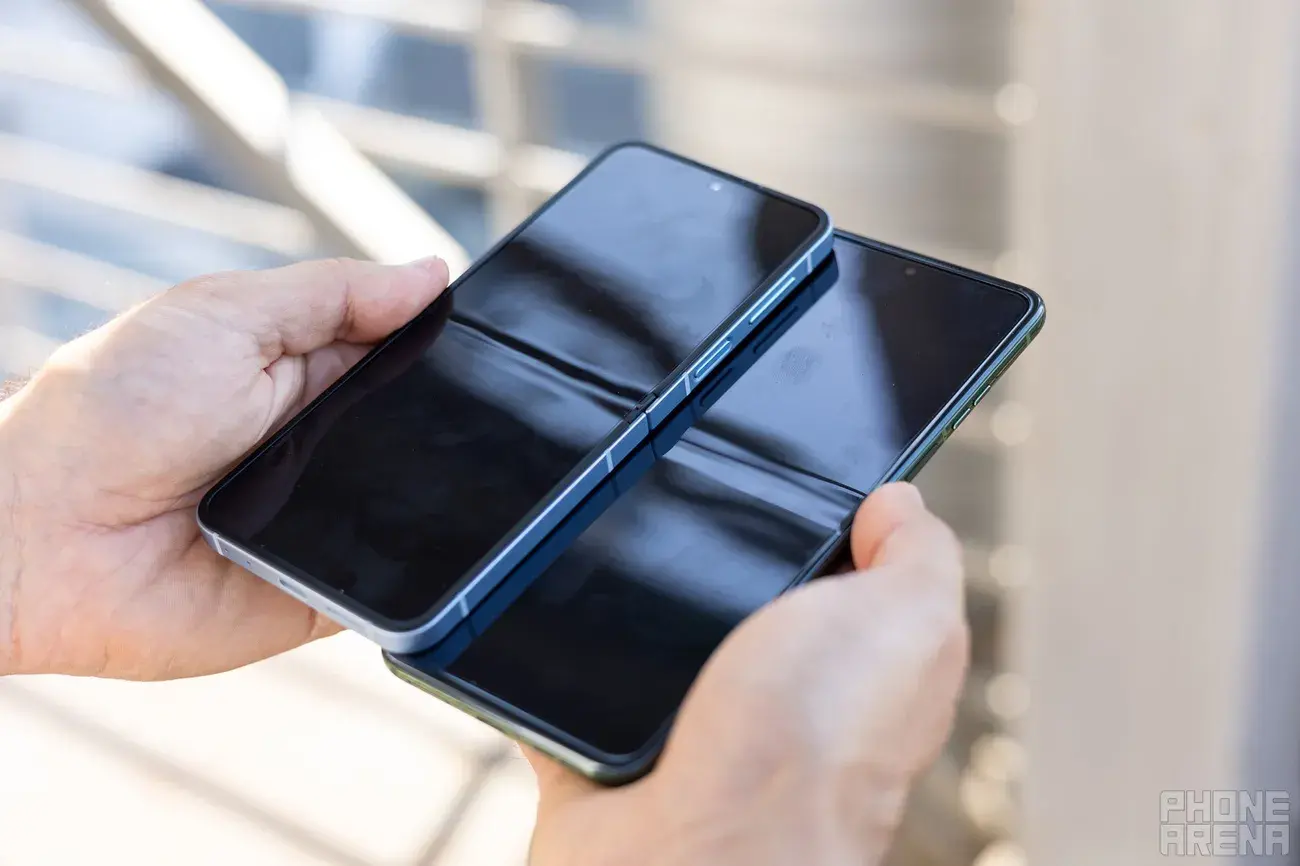
You can clear see how more visible the crease on the Z Flip 6 is (left) compared to the Razr Plus (right). (Image by PhoneArena)
Besides the larger cover displays, there are some changes to the materials used, with the
Razr Plus
now rocking a silicone/vegan leather lower back panel. The Z Flip 6 still has a glass back panel, which is easier to break and shows fingerprints.
Colors-wise, the
Razr Plus
comes in Midnight Blue, Spring Green, Peach Fuzz, and Hot Pink hues. Samsung offers more color variants with the Z Flip 6: Silver, Shadow, Yellow, Blue, Mint, Crafted Black, White, and Peach.
When it comes to the unboxing experience, Motorola is undoubtedly the one that takes the cake in this case. The
Razr Plus
comes with a color-matching case and lanyard. The Z Flip 6, on the other hand, does not include such gifts. Unfortunately, both phones lack a charger in the box, though.
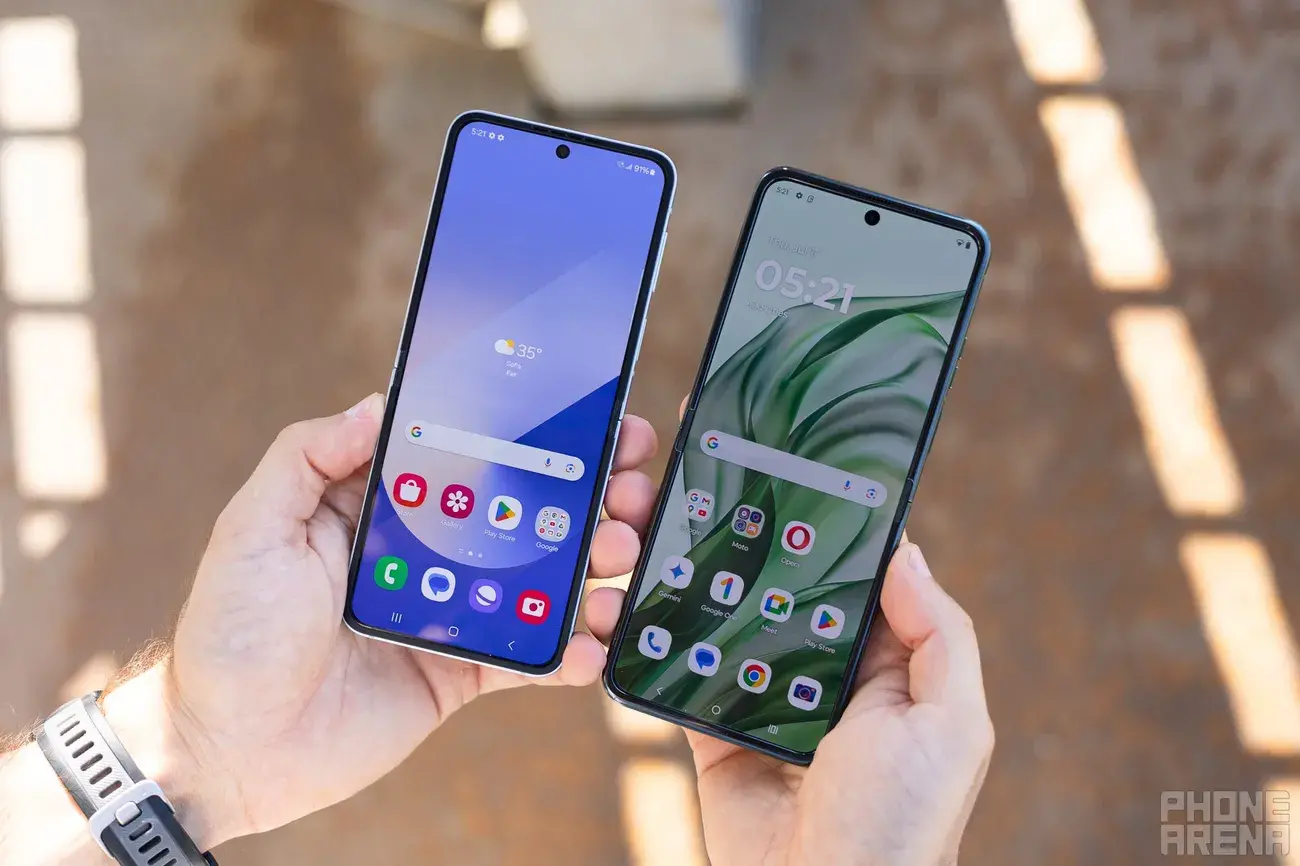
Looking at them unfolded definitely shows how the Z Flip 6 would be more comfortable to hold than the Razr (Image by PhoneArena).
As we already mentioned, the
Razr Plus
cover display is larger, coming in at 4 inches, while the
Galaxy Z Flip 6
has a 3.4-inch one. But the differences do not end there.
Motorola has also made the cover display 165Hz, which ensures a much smoother scrolling and swiping experience compared to the 60Hz refresh rate of the Z Flip’s cover screen. We definitely felt that as we handled the two phones back to back when they are closed.
The main, foldable display of the
Razr Plus
(2024) is also bigger than that of the Z Flip 6, measuring 6.9 inches vs. 6.7 inches. However, as mentioned earlier, Motorola has done a much better job at avoiding a crease in the middle of the display than Samsung.
We found out that the main displays of the Z Flip 6 and the
Razr Plus
(2024) are about as equally bright during our display lab tests. Our two units were also somewhat similar in terms of color accuracy.
Performance and Software
The Z Flip has the newer chip and more horsepower
s
Gen 3 that powers the
Razr Plus
(2024), especially when it comes to multi-core processing and graphics.
The benchmark results we got during our performance test showed us that the Z Flip 6
beats
the
Razr Plus
in all categories when it comes to performance. The Z Flip 6 did feel somewhat more snappy in real life, and it seemed to do better during gaming sessions, matching the 3DMark Extreme graphics test results we got.
As for storage and memory, the Razr only comes in a 12/256GB option in the US, while Samsung gives the option to choose from 12/256GB and 12/512GB variants of the Z Flip 6. Both phones come with fast and power-efficient UFS 4.0 storage and LPDDR5 RAM.
Samsung also wins when it comes to software support, with 7 years of Android updates and security patches on the Z Flip 6. In comparison, Motorola continues to offer 3 years of Android updates and 4 years of security patches with the new
Razr Plus, just like with its predecessor
.
Camera
The Razr comes out on top (if you don’t need ultra-wide)
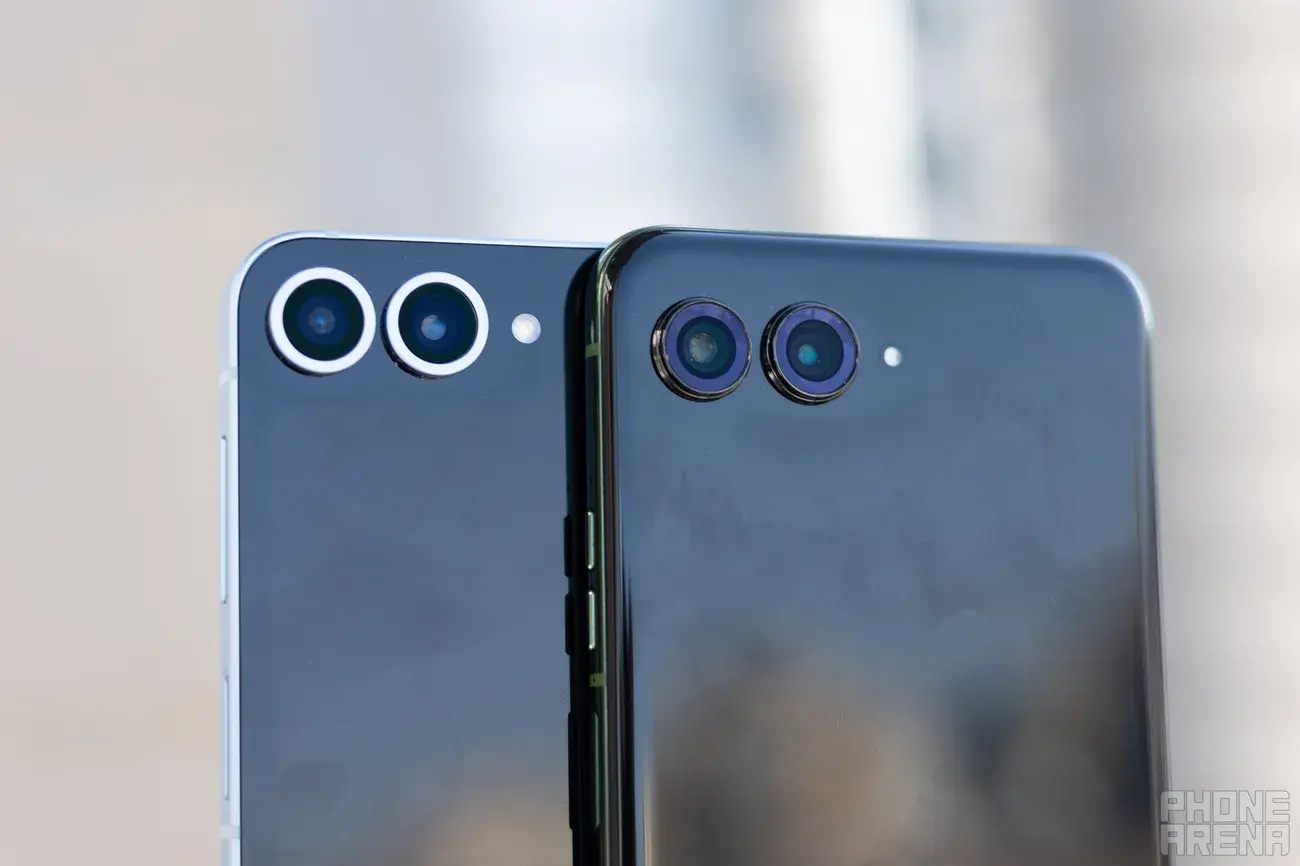
A closer look at the Galaxy Z Flip 6 and Razr Plus (2024) dual cameras (Image by PhoneArena).
Both phones come with dual camera systems at the back, with the 50MP main cameras. The secondary camera on the Z Flip 6 is what you would expect from a phone in 2024: a 12MP ultra-wide one. Motorola, however, has opted to swap the ultra-wide camera on its premium flip phone with a 50MP 2x telephoto camera.
The selfie cameras are very different between the Z Flip 6 and
Razr Plus
(2024), with the former rocking a 10MP camera and the latter a 32MP one. Then again, front-facing cameras on a flip phone are not that important, considering you can use the main camera at the back and the cover display in tandem to get much better photos.
As you will see from the photo samples bellow, the
Razr Plus
(2024) manages to offer the better image in almost all cases. That being said, the Z Flip 6 has such good zoom even without a telephoto camera that it almost feels like there are three cameras at the back instead of two. So, you kind of have to decide between better images or a more comprehensive camera set.
Main Camera
Not only do the colors on the Razr look more natural, but the image also appears to be sharper. Apart from that the HDR performance seems to be similar (both of them are good), and the Z Flip 6 has a wider field of view so it captures more inside the image.
In the low-light scenario we continue to see the
Razr Plus
(2024) offer better sharpness, especially when you look at the edges of the shot. Colors are also much more accurate on the Motorola. We do find the Z Flip 6 main camera to have done better at bringing out more detail from the shadows.
Zoom Quality
Despite not having a telephoto camera, the Z Flip 6 manages to match the
Razr Plus
(2024) in terms of zoom quality. The Razr’s 2X telephoto does offer more detail in the dark areas, though, and its colors look much better in comparison.
Ultra-wide Camera
Of course, since the Razr does not have a dedicated ultra-wide camera, we cannot really compare one to that of the Z Flip 6.
general
, we like the image quality from the ultra-wide camera on the Z Flip 6, and it almost feels like the phone has three cameras at the back given how well it also performed when zooming in digitally.
Selfies
The
Razr Plus
(2024) provides much more natural colors, whereas the Z Flip 6 makes the skin color sickly by throwing in a green tint to it. There is also more detail in the selfie from the Motorola, and it has been better exposed to show more of the eyes without blowing out the highlights in the image.
Battery Life and Charging
The Razr still prevails in this category
The Z Flip 6 comes with a slightly larger 4000 mAh battery this time, which is exactly what the
Razr Plus
(2024) has. That means any battery life differences you see from our dedicated battery tests below is a result of how power efficient the two foldables are.
For context, last year the
Razr Plus
faired massively better in our video streaming battery tests, but the Z Flip beat it by about an hour or two during our web browsing and 3D gaming battery tests.
PhoneArena Battery Test Results:
Samsung really improved the battery life of the Z Flip series compared to last year’s generation, and that shows here. That said, it still has some ways to go before being able to last as much as the
Razr Plus
in our Web Browsing and Video Streaming battery tests.
Overall, the
Razr Plus
(2024) is better at preserving its battery than the Z Flip 6, but the latter is not that far behind anymore.
For charging, there is no doubt the new
Razr Plus (2024)
beats the Z Flip 6 by a landslide as it comes with 45W wired charging. The Z Flip 6, on the other hand, maxes out at 25W. The two come with the same maximum wireless charging speed though, reaching 15W with an appropriate charger.
Specs Comparison
| Galaxy Z Flip 6 | Razr Plus (2024) | |
|---|---|---|
| Size, weight |
Folded: 71.9 x 85.1 x 14.9mm Unfolded: 71.9 x 165.1 x 6.9mm Weight: 187g |
Folded: 74 x 88.1 x 15.3 mm Unfolded: 74 x 171 x 7.2 mm Weight: 187g |
| Screen |
Inner display: 6.7″ OLED, 120Hz Cover display: 3.4″ OLED, 60Hz |
Inner display: 6.9″ OLED, 165Hz Cover display: 4″ OLED, 165Hz |
| Processor | Qualcomm Snapdragon 8 Gen 3 (4 nm) | Qualcomm Snapdragon 8s Gen 3 (4nm) |
| RAM, Storage |
12/256GB 12/512GB
UFS 4.0 storage |
12/256GB 12/512GB
UFS 4.0 storage |
| Cameras |
50MP main 12MP ultra-wide 10MP front |
50MP main 50MP telephoto 32MP front |
| Battery | 4000 mAh | 4000 mAh |
| Charging |
USB-C 25W wired 15W wireless 4.5W reverse-wireless |
USB-C 45W wired 15W wireless 5W reverse-wireless |
There are numerous differences between these spec sheets. We have different sizes between the Z Flip 6 and
Razr Plus
(2024), very different camera systems, as well as different charging speeds.
Which one should you buy?
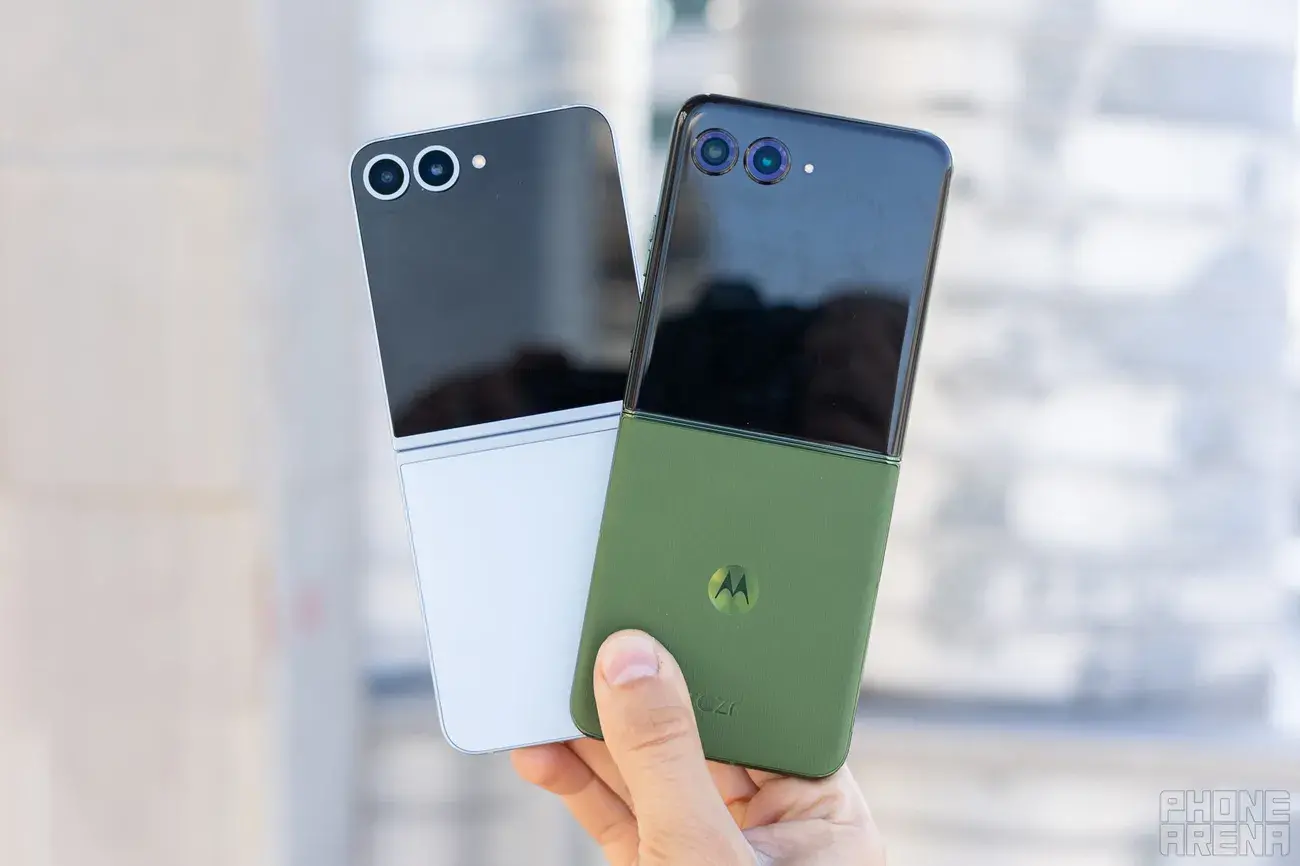
The Z Flip 6 and Razr Plus (2024) are both great flip phones, but there’s a clear winner (Image by PhoneArena).
It seems this year flip phone lovers will have a somewhat tough decision to make thanks to the
Galaxy Z Flip 6
and the
Razr Plus
(2024) from Motorola. Samsung offers a more compact and durable device with longer software support and a more powerful chipset, showing its long experience in the manufacturing of
foldable phones
.
There’s also the fact that the Z Flip 6 comes with all of the Galaxy AI features Samsung introduced with the S24 series, such as the ability to transcribe, translate, and summarize voice recordings directly in Notes, for example. The
Razr Plus
, on the other hand, mainly relies on Google’s powerful Gemini smart assistant, with an easy access to it via the words “Hey Google.”
But the
Razr Plus
has managed to evolve to a level where it can rival and even surpass the likes of Samsung in more than one area. You get faster charging, two larger and more modern displays with higher display refresh rate, a much less visible crease, and a significantly better camera system.
Another benefit for the
Razr Plus
(2024) is that it costs $100 less than the Z Flip 6. That makes it a big threat to Samsung’s clamshell foldable in our opinion, especially considering its cameras and screens.
So, if you are looking for longer software support and the best performance possible the Z Flip 6 sounds like the right choice, but even then we would recommend the
Razr Plus
(2024) as the better option since it offers much more benefits for a lower price.
VIA:
phonearena.com

0